AI didn’t replace the need to think. It replaced the need to know everything before starting.
This website is a Roble Media Lab project, and the client was us.
Before we ask any business to trust us with a website, their search visibility, or an AI system, we think it is fair to show that we run the same tools on our own business, with a real deadline and a real budget. So this post is a build log, including how each part got to the version running today.
The short version: this site went from a single static landing page to a full multi-page website with booking, a working contact process, analytics, and the publishing system this post sits in. It took under two weeks of calendar time, and most of that went on decisions rather than construction: which booking tool, whether to build the contact form ourselves, how the publishing system should work. Those decisions are settled now, which is why the build times on our pricing page are measured in days. This post is the record of making them.
Updated 14 September 2026. The "after" image below was reshot the same day, after the homepage rebuild described further down.
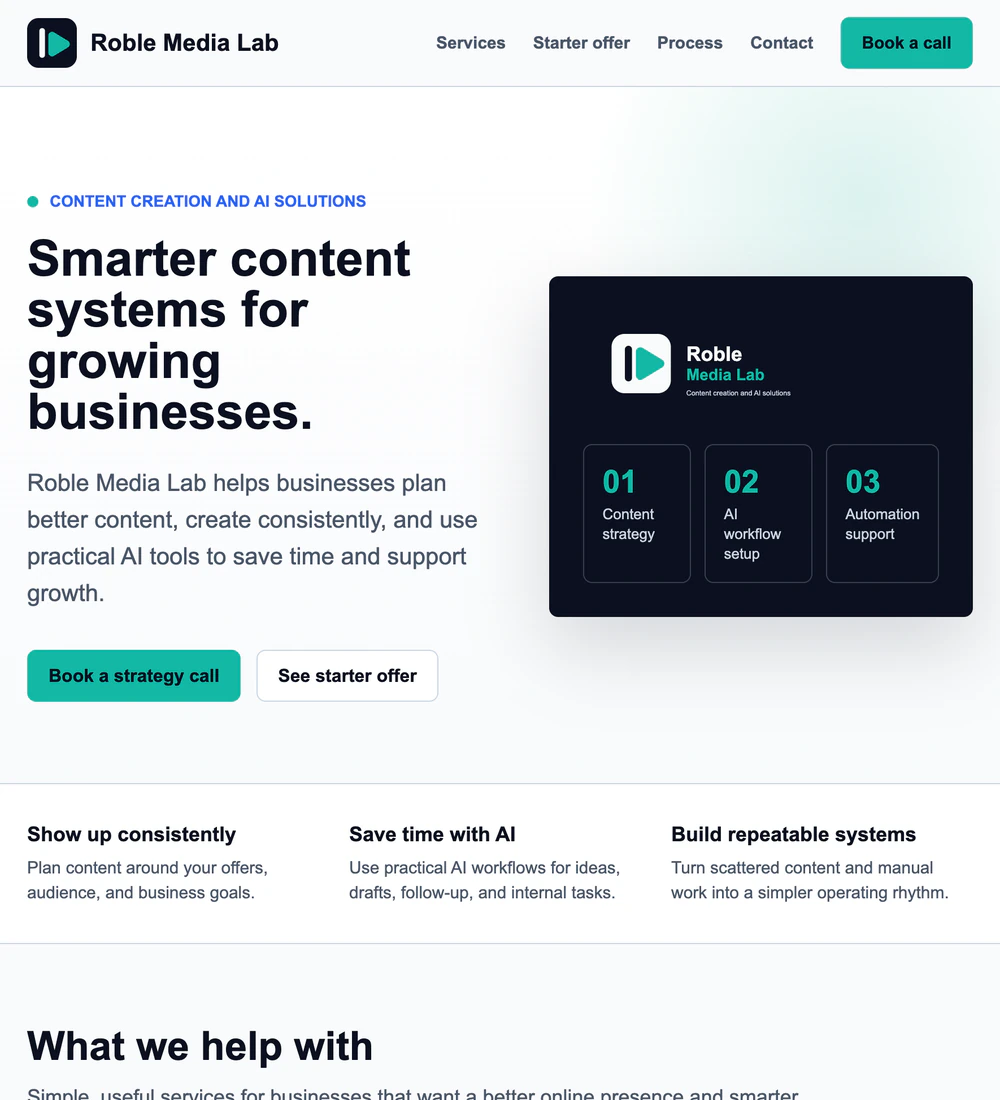
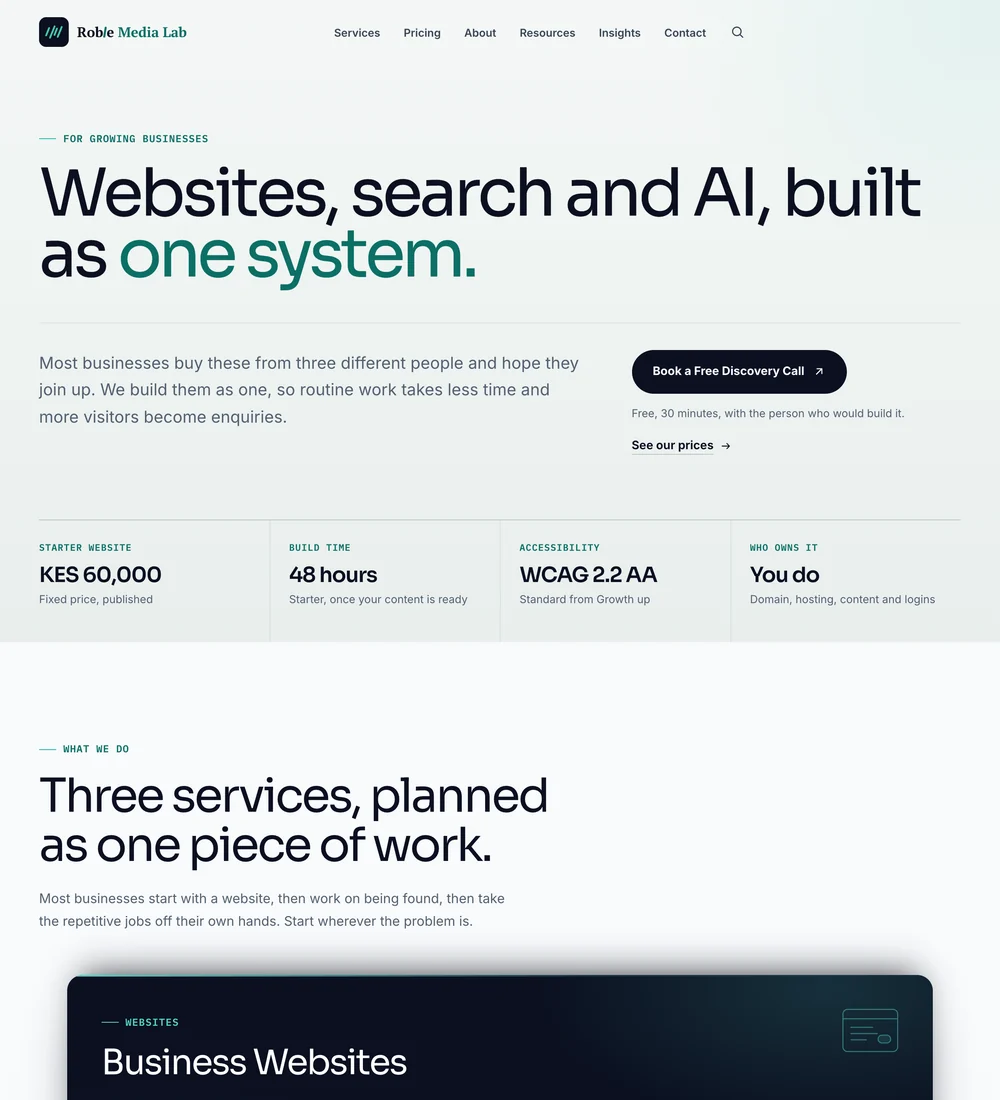
The logo changed between those two screenshots as well. The first identity was a play button. It said "media" and not much else, and it could have belonged to anyone. The mark now is four leaning strokes, and they are rain: roob, the Somali root of Roble.
The wordmark carries a fifth stroke, and that one is doing a letter's job. There is no "l" in "Roble" in the lockup at all, which makes it a detail that is easy to lose in production. Typed as live text, the name draws an ordinary "l" and still reads correctly to anyone who is not looking for it. Passed through a tool that only reads filled shapes, the stroke vanishes and the name comes out as "Rob e Media Lab". So nothing here types the name any more. The site and the printed business card both place the real artwork, which is the only version that holds up either way.
Why we built it ourselves instead of outsourcing it
We could have paid another studio to make a nice site. Plenty of businesses do, and there is nothing wrong with that. But the whole point of Roble Media Lab is helping growing businesses with websites, SEO and AI systems in a grounded way. Selling that without doing it on our own business first would be hollow.
So we treated our own website as a client project. Same discovery, same build process, same standards we apply to paid work. If these tools genuinely let a small team ship real systems quickly, we should be able to show it, not just say it.
What runs on this site today
In plain terms, here is what this site does right now:
- A full multi-page website, built to load fast even on slower connections.
- Booking that goes straight to a calendar: pick a time and the invite arrives automatically.
- A contact form that lands with a real person: spam-checked, stored safely, and answered within one business day.
- A click-to-chat WhatsApp button. In Kenya and much of the world, that's where first conversations actually happen.
- Free checks, checklists and templates you can run on your own business, with the result on screen and no email address asked for.
- Analytics that wait for your permission. Google Analytics loads only after you accept the cookie notice, and until then Cloudflare counts visits without setting a cookie.
- The blog and publishing system this very post sits in.
The tools behind it were mostly ChatGPT for thinking through plans, Claude for building and fixing the actual site, Cloudflare for hosting, and GitHub for keeping versions safe. None of them do the thinking for you. They make the building fast. Deciding what is worth building, and in what order, is still the real work, and it is the part we spend the most time on with clients too.
How each part earned its place
Nothing on this site was chosen once and left alone. Each part went live in a simple form, ran against real use, and was replaced when something fitted better.
Booking shows the pattern most clearly. It started on one scheduling tool and moved to the one it runs on now, which fitted better. The contact form took the same route. It began as a third-party embed and became our own build, which asks sharper questions so we understand a visitor's problem before the first conversation. Ship it, watch how it is used, replace what does not earn its place: that is the loop we run on client work too.
Most of the careful work went into making other companies' tools sit properly inside our own pages. A form or a booking widget brings its own code and its own assumptions, and fitting it into a fast, accessible page means testing it one step at a time until it behaves. We build that time into every project plan now. The tools make these problems solvable, and the plan leaves room to solve them.
AI didn't replace the need to think. It replaced the need to know everything before starting.
That single idea shapes how we scope every project.
The one shortcut we refused to take
Here is the choice we are proudest of, and it cost nothing but honesty.
When we built the site, we set up the sections a normal agency site has. A place for testimonials. A place for client case studies. A "trusted by" strip. The structure is all there, ready.
They are empty. On purpose.
We could have written a few convincing quotes and nobody would have known. But this business is built on being straight with people about what technology can and cannot do, and that has to start with what we publish about ourselves. So those sections stay empty until they are true. The day a project is complete and the client is happy to be named, they fill up honestly. If we would fake a testimonial, why would you trust anything else we tell you?
The homepage, rebuilt in September
In September we rebuilt the homepage around one test: within a single screen, can a visitor tell what we do, who it is for, why they should believe it and what to do next?
Phones are where that test is hardest to pass. A booking button in the header works on a laptop, but on a phone the header's links fold into a menu and the button goes with them, so the first screen can carry a headline and an introduction with nothing to act on. Our hero now carries "Book a Free Discovery Call" itself, sized to be the easiest thing on the screen to tap. Wide screens still show the same button in the header, so on the homepage that copy stays hidden until the hero's has scrolled away. Two identical buttons in one view make a page look unsure of what it wants.
Under the introduction sits a row of four facts: the Starter price, the build time, the accessibility standard and who owns the finished work. Each one is read from the same data as the pricing page, so the homepage cannot quote a number the pricing page has since changed. Even the cookie notice follows the test. On a short phone it waits until the booking button has scrolled clear, instead of sitting on top of it.
The empty testimonial sections described above led to one more change. Where a homepage would usually put client quotes, ours now points at three things you can check for yourself: the free tools, the articles, and this build log.
What this means if you run a growing business
If you have been told that AI and modern web tooling are only for technical teams, this build says otherwise. What it takes is a clearly named problem, a small first scope, and the habit of improving it once real use shows what to change. The tools have become good enough that the limiting factor is no longer engineering headcount. It is knowing what to point the tools at.
That judgement is where most of the value sits, and it is learnable. If you want the longer version of how we choose those opportunities, we wrote it up in a practical guide to AI for small businesses.
Judge the work directly
This site is a working example of our business websites service: the speed, the search structure, the contact process that reaches a person within a business day. You are reading the portfolio piece.
If that is the kind of partner you are looking for, see how we can help, book a short discovery call, or send us a message. No pressure, no jargon. Just an honest look at whether there is a sensible way we can help.